
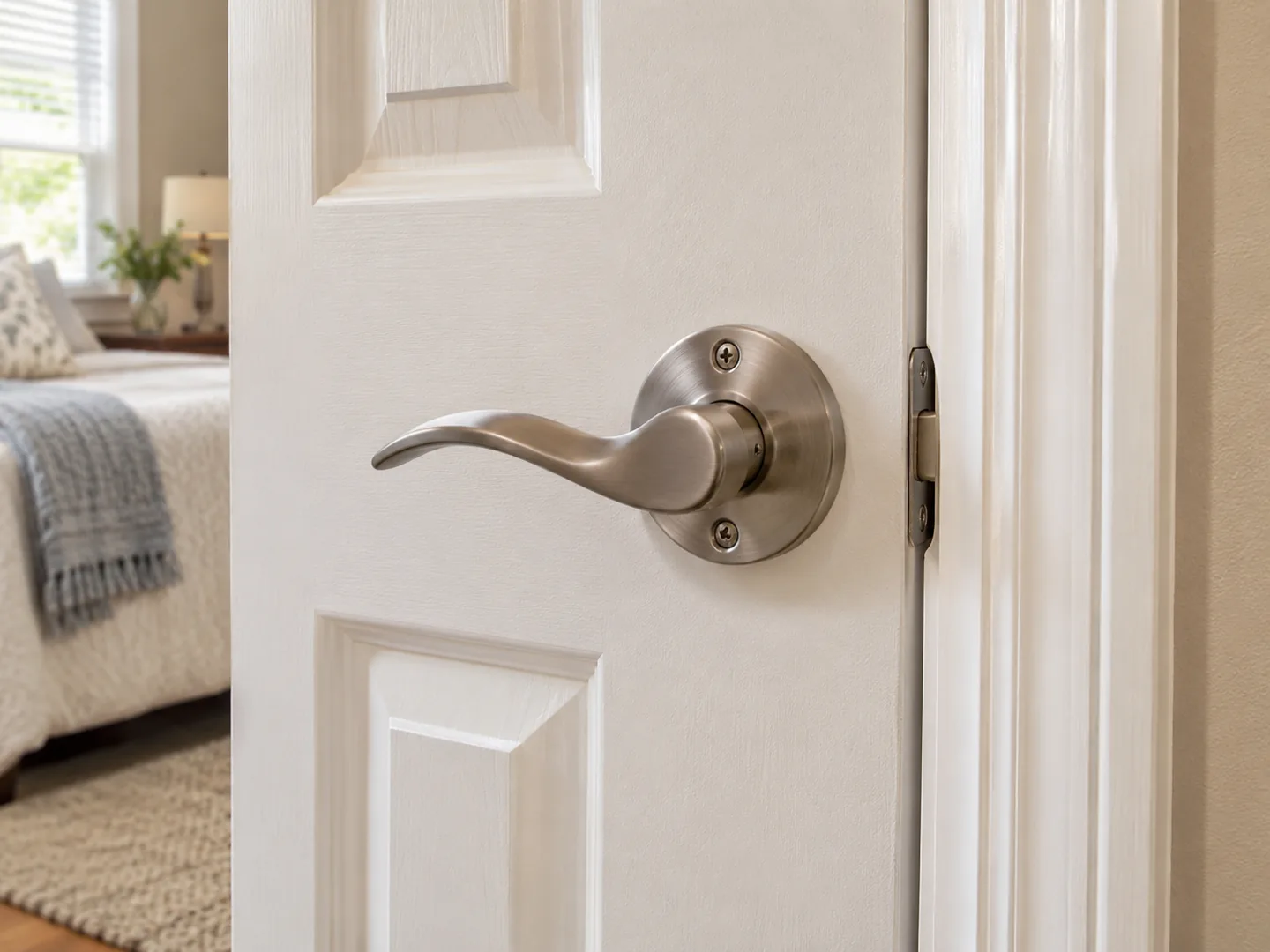
Give attention to loose door hardware that affects ordinary entry, closing, privacy or reliable operation, and describe the problem before choosing a replacement. A handle that moves, a door that rubs and a latch that misses its opening may look like one problem, but they should not automatically receive the same repair.
Before guests arrive, focus on the doors people will use rather than ordering a matching set of new hardware for the whole house. Your aim is a clear assessment request: which opening is affected, what happens during ordinary use and what needs to work differently. This guide is for that planning conversation, not for dismantling locks or altering protective doors.
Name the door and the part that moves
Start with a location that another person can identify without guessing. “Guest bathroom off the hallway” is clearer than “the small door.” Say whether the affected opening is an interior room, exterior entrance, closet or another kind of door. Mention any special role you already know about.
Then distinguish the visible parts. Does the lever move relative to its base? Does the round mounting plate move against the door? Does the whole door move near a hinge? You do not need technical certainty, but describing the movement is more useful than calling everything a broken lock.
If the part looks unstable or the door cannot be used reliably, stop repeating the movement to show the problem. A written description and a photograph may be enough to begin the assessment. Explain how the room is currently accessed rather than letting a guest discover the issue for the first time.
Describe operation before deciding the cause
Write what happens when the door is used normally, if it is safe to observe. Perhaps it closes only when lifted, the lever does not return as expected, or the latch does not engage without pressure. Keep that behavior separate from your preferred repair.
Schlage’s latch troubleshooting guidance identifies loose hardware, strike alignment and worn components as different possible contributors to operation problems. The useful takeaway for a repair request is that looseness can be relevant, but it does not establish the cause of a particular door’s behavior.
Do not assume a new handle will correct every issue at the opening. Likewise, a visibly loose screw is not permission to substitute any fastener that appears to fit. The product, door condition and actual connection need to be considered together.
Use a small door-by-door record
A simple record can contain four entries: location, observed behavior, existing product information and desired result. For the guest bathroom, that might read: “Handle plate moves at the door; existing model unknown; want reliable operation and normal privacy function.”
Keep an exterior-door concern on a separate line. Record whether the issue is closing, latching or the lock function, without publishing keys, access codes or security details. Share sensitive information through the private service process rather than posting it with a public photograph.
For a closet, explain what interferes with use: a knob that comes loose, hardware that catches clothing or a door that cannot stay closed. These details help distinguish a fitting problem from a storage or layout problem that a replacement handle would not address.
Prioritize reliable use over matching finishes
Put operation concerns first and appearance preferences second. You may want all door levers to match, but that is a separate decision from making one unreliable door usable. It is reasonable to discuss both; it is unhelpful to make the functional repair depend on finding a finish you have not selected.
When guests have particular access needs, discuss those directly. Explain the activity that is difficult instead of selecting a product from a general recommendation. A change in handle style is not automatically an accessibility solution for every person or opening.
Do not bypass a closing device, remove protective hardware or wedge a special-purpose door open to make a visit more convenient. Identify fire-rated, shared-building, pool-barrier or other protective arrangements to the appropriate qualified provider. An ordinary room-door repair request does not establish the requirements for those systems.
Save product information without taking the hardware apart
Look for existing purchase records, packaging or a model number you can see without disassembly. A manufacturer name and a clear view of both sides can help with identification. Do not remove a working component merely to create a sample before the visit.
If you already bought replacement hardware, send the exact model and installation information. Confirm whether it is intended for passage, privacy or another function. Similar appearance does not settle compatibility, and the correct plan may be to return a product rather than force it into the opening.
Keep parts and paperwork for each door together. Label boxes by location if multiple products are involved. A matching finish is not enough to identify which product belongs on which door, particularly when functions differ between rooms.
Include the finish work in the decision
A different fitting can reveal old marks or an existing finish outline. Ask what happens if the replacement footprint does not cover the previous location. Discuss whether patching, touch-up or a broader finish change is part of the proposed work.
Also say what should remain unchanged. You may want a localized adjustment while keeping the existing handle, or you may accept a different appearance after suitability is confirmed. Naming that preference prevents a repair discussion from quietly becoming a full hardware upgrade.
Plan the appointment around room use
Tell Keystone when guests arrive and which doors must remain available during the assessment. Arrange access with the person responsible for the property. If the issue is in an occupied guest room, choose a time when the room can be reviewed without handling another person’s belongings.
Ask for the initial findings and proposed scope before authorizing repair work. The request might need an adjustment, product replacement or a different evaluation. A useful result is a confirmed next step, even when it is not the quick tightening you originally imagined.
At closeout, review the agreed operation and record any remaining concern. Keep the model information if a part was replaced. Do not describe the opening as fully repaired if only one component was addressed and another issue remains deferred.
Keystone’s door and trim services cover appropriate work for review. Get Started with your door-by-door observations and deadline. Scope and price should be approved at the property before work begins; same-visit repairs depend on the condition, materials and practical plan.
Posted by: Alex Keystone
Sources & Further Reading
- Schlage Residential: Latch That Will Not Retract