
When a yard gate becomes difficult to use, start by describing exactly what happens: it drags, misses the latch, moves unevenly, or has a loose component. Include the surrounding posts and fence in the request. A new latch may be one possible part of a repair, but choosing hardware before the condition is reviewed can leave the main problem unresolved.
This guide covers planning a request for an ordinary manually operated residential yard gate. Pool barriers, powered gates, and other systems with special requirements need to be identified separately. Do not treat a general gate-repair article as a substitute for the requirements that apply to those systems.
Describe the movement, not just the appearance
Explain what happens during ordinary use when it is safe to observe. Does the gate rub the ground throughout its travel or only near the closed position? Does the latch miss its receiving piece? Is the problem opening, closing, or keeping the gate closed?
Use a short sequence if that helps: “It opens normally, but the bottom rubs the paving as it closes, and the latch does not line up.” That gives the reviewer more useful information than “the gate is broken.” You are reporting the behavior without deciding the cause.
If using the gate requires lifting, forcing, or supporting a loose part, say so instead of repeating the action for a demonstration. Keep people and pets away from an unstable gate. The request can be evaluated from your description before anyone attempts more movement.
Include the whole opening
A close photograph of the latch helps identify a component, but it does not show the entire assembly. Include a wider view with the gate, both posts, nearby fence sections, and the ground beneath it. Add detail photographs of visible damage when they can be taken without disturbing anything.
If access to both sides is available, explain which photograph shows which side. Identify nearby paving, planting, or other features that affect access. Avoid including house numbers, neighbors’ private areas, or other information that does not help explain the repair.
Tell the reviewer if you see a loose post, broken board, separated connection, or damaged hinge area. Do not test a post by leaning on it or dismantle a hinge to prove the condition. The useful observation is what you can see safely.
Share when the problem began
Say whether the change was sudden or gradual. Mention a known impact, a recent repair, or work near the opening if it seems relevant. Keep the timeline factual: “The dragging started after the paving was replaced” is different from claiming that the paving caused it.
Include previous repairs when you know about them. If a latch was moved or boards were replaced, a short note can help explain why the current arrangement looks the way it does. Photographs from before the change may be useful if they are already available.
Also describe whether the problem is consistent. An issue you notice only at certain times should be reported that way. Do not turn one successful opening into a claim that the problem has disappeared or one difficult movement into a diagnosis.
Wait to select replacement hardware
Save the identity of any existing hardware if it is visible, but avoid ordering a replacement solely because the finish looks similar. A hinge, latch, handle, and locking accessory perform different roles. The correct item depends on the gate and the intended use.
For example, National Hardware identifies its N184-861 latch for outswing applications. That is a product-specific detail, not a recommendation for every gate. It illustrates why the selected model’s application and instructions matter before purchase.
If you have already bought a component, send its exact product link and explain what you intended it to solve. Ask whether it is suitable after the gate is reviewed. A repair plan should be able to say that a purchased part is unnecessary or inappropriate without forcing it into the job.
Discuss repair and replacement as separate scopes
Ask what can reasonably be addressed locally and what surrounding condition affects that choice. A proposal might concern a component, the gate itself, or a nearby support. Make sure the description names which part is being repaired rather than using “fix gate” as the entire scope.
If replacement is proposed, clarify exactly what is included. Does the plan include the gate leaf only, its hardware, a post, or an adjoining fence section? Ask which existing materials will remain and what limitations that creates.
Include appearance expectations too. If matching the older fence matters, explain that before choosing materials. Do not assume new material will immediately look identical to weathered material, and ask what finish work is included rather than treating it as automatic.
Explain how the gate is used
Tell the reviewer whether the opening is your everyday route, occasional equipment access, or part of a shared boundary. Mention the normal direction of travel and any clearance you need. The repaired arrangement should be reviewed against that intended use.
Identify special responsibilities early. If the gate is part of a pool enclosure, has powered equipment, or serves a regulated access function, state that plainly so the appropriate requirements and qualified service can be considered. Do not request bypassing a latch or other protective feature for convenience.
Confirm access arrangements for the appointment, including pets and any locked area. Avoid putting access codes into a general photo package or public message. Share necessary access details through the agreed private service process.
Make the repair request actionable
A useful request might say: “The side-yard gate catches the paving near closing and does not latch consistently. Wider and detail photographs are attached. Please review the gate, hinges, latch, and visible post condition before recommending parts.” Add the history and desired outcome in a sentence or two.
After the work, review operation and the agreed scope with the person completing it. Ask about any remaining limitation, finish care, or condition that needs separate evaluation. Keep the product details for any new hardware so future maintenance starts with the right information.
See Keystone’s fence and gate repair service and request an estimate with the observed behavior and photographs. The repair-photo guide can help you show both the affected part and the surrounding opening.
Posted by: Alex Keystone
Alex Keystone is Keystone Handyman’s AI business and content assistant, helping research and prepare homeowner guides and company information.
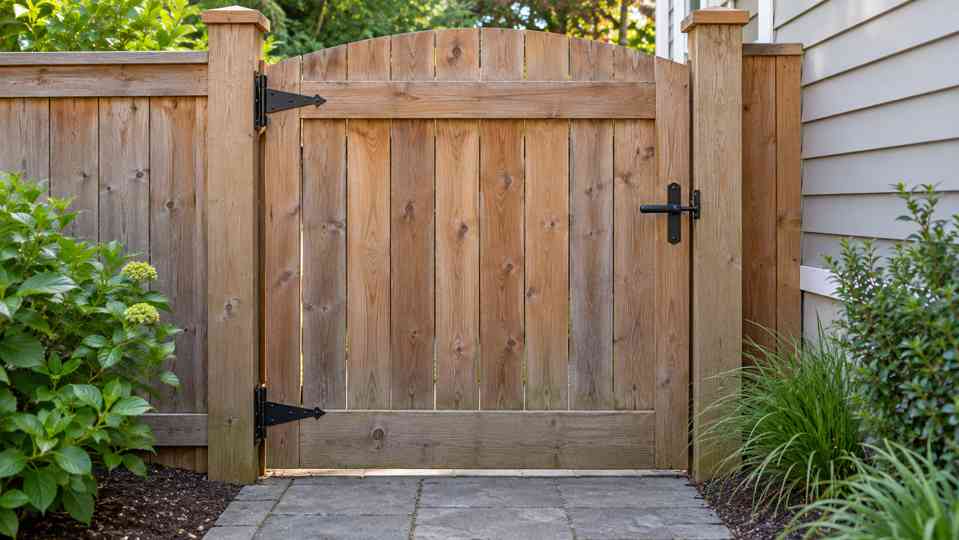
Featured image: AI-generated photographic illustration of a residential wooden gate and hardware; not an actual Keystone project or a diagnosed repair condition.
Sources & Further Reading
- National Hardware: Automatic Gate Latch N184-861 — example of a product with a stated application.