
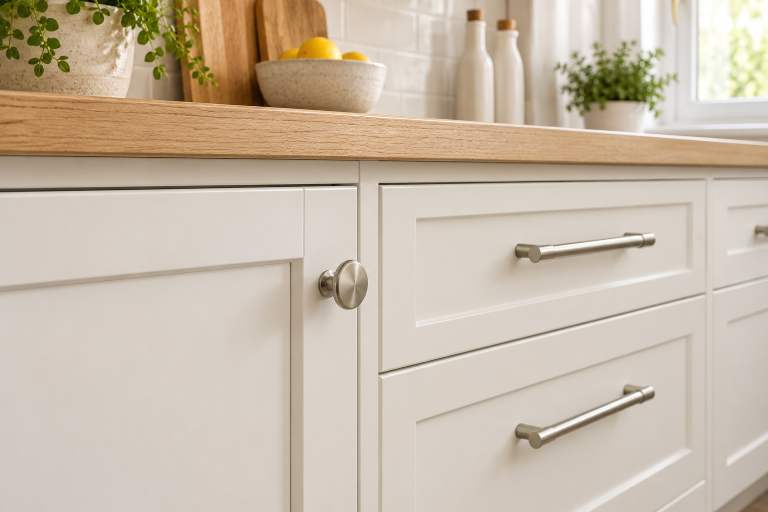
Featured image: AI-generated illustration of cabinet hardware.
New knobs and pulls can change how a kitchen looks and feels, but a successful update starts with fit. Before ordering a full set, identify the existing mounting pattern, decide what you want to improve, and check a sample against the actual cabinet. Finish and style matter, but they are only part of the decision.
This guide is about planning an ordinary hardware update. It is not a drilling guide or a promise that every cabinet can accept the same replacement. The condition of the doors, drawers and existing mounting points still needs to be considered.
Decide whether the problem is appearance or function
Start by finishing this sentence: “I want new hardware because…” Perhaps you dislike the finish, find the current knobs awkward, or want a more consistent appearance. That is a different request from a handle that will not stay secure or a drawer that catches when opened.
Describe functional concerns separately. Replacing a pull does not automatically address a drawer problem, damaged mounting area or misaligned door. A clear description helps keep a small decorative update from being confused with a repair that needs evaluation first.
Write down what you like about the current arrangement, too. You may want to keep the same positions and general size while changing the finish. Preserving a feature that works can be just as important as changing one that bothers you.
Count the pieces by location
Walk through the kitchen and make a simple inventory. Separate doors from drawers and note which currently use knobs, pulls or no hardware. Include the small drawer you rarely open and any cabinet hidden behind an open door.
Do not assume that every pull in the room is the same size. Group them by location or visible type, then confirm the dimensions for each group. A photograph of the whole kitchen can help you mark where a different piece belongs.
Keep the count with the product information you collect. If you later change your mind about using knobs on doors and pulls on drawers, update the list before purchasing. This is easier to review than an order quantity that no longer matches the plan.
Match mounting information, not just appearance
For a replacement pull, check the spacing of the existing mounting holes against the replacement’s specifications. Product listings may distinguish mounting dimensions from the overall shape or length. A handle that looks similar in a photograph is not enough evidence of fit.
Liberty’s Adjusta-Pull product information documents an adjustable center-to-center mounting range for that particular product. That model is listed as discontinued, so this is an example of reading specifications, not a purchase recommendation. The useful lesson is to read the exact model’s dimensions; do not assume every pull is adjustable or shares that range.
If you cannot confidently identify the measurements, send clear photographs and ask for help confirming them. Keep inches and millimeters clearly labeled in your notes. Do not round an uncertain measurement and treat the rounded number as a confirmed match.
Consider what the old hardware may reveal
A smaller replacement may leave part of the previous hardware’s outline visible. A different mounting pattern may involve additional finish work. Those are planning questions to discuss before deciding that a hardware swap is a complete kitchen refresh.
Look at the visible finish around the current pieces without dismantling anything you are uncomfortable handling. Note marks, worn areas or previous repairs. A close photograph can help explain why you want the appearance reviewed along with the hardware.
If new holes or finish repairs are proposed, ask what the completed surface is expected to look like. Decide whether that work belongs in the current scope or whether a different hardware choice would better suit the existing cabinetry.
Try a sample before committing to the room
Choose a sample that represents the style and finish you are considering. Hold it near the cabinet in normal room lighting and compare it with the door color, countertop and nearby finishes. A screen image is useful for narrowing choices, but the physical sample gives you something concrete to discuss.
Think about ordinary use as well as appearance. Can you comfortably grasp the shape? Does it feel suitable for the people who use that cabinet? Ask how it will sit once installed rather than judging only how it looks loose in your hand.
A sample review does not require drilling a test hole. Confirm the proposed mounting method before any permanent change. If the sample is unsuitable, changing the selection at this stage preserves more options.
Check the surroundings
Look at how neighboring doors and drawers move and where the proposed hardware would sit. Include nearby walls, appliance handles and other pieces that may affect the arrangement. Point out any existing contact or clearance concern during the review.
Do not assume a larger handle is a better choice simply because it looks more substantial. The useful size depends on the particular door or drawer and how it is used. Ask the installer to review the actual layout.
If the kitchen includes several hardware styles, decide which differences are intentional. A consistent finish may be enough; every piece does not have to be visually identical. The important part is making that choice deliberately before installation.
Keep product details together
Save the model number, finish name, dimensions and manufacturer instructions for the exact item. Keep track of whether mounting hardware is included and ask whether it suits the cabinet construction. Avoid substituting an unspecified screw or other component merely because it appears to fit.
If you are supplying the materials, confirm that arrangement with the person doing the work. Agree on who checks compatibility, what happens if a part is missing, and how an unsuitable item will be handled. This prevents a shopping decision from quietly becoming an installation assumption.
Keep packaging until the selection and condition have been checked. For your own records, save the product details after the work as well. They can be useful if you later want another matching piece.
Make the scope easy to review
A useful request might read: “Replace the kitchen door knobs and drawer pulls, keep existing positions where practical, and review the loose pull on the lower drawer before installation.” Add the inventory and selected product details.
Separate optional finish work or door adjustments from the hardware replacement itself. That makes it easier to understand which items are approved and which still need a decision. A longer wish list is not a reason to blur the boundaries of the current work.
Before moving forward, confirm the material choice, mounting plan, visible-finish expectations and any unresolved concerns. Good craftsmanship starts with a shared understanding of what the finished result should be.
Common questions
Should I buy all the hardware first?
A sample and complete specifications are a sensible starting point when fit is uncertain. Confirm the plan before committing to the full quantity. Your installer may need information about the cabinet and mounting points that an online product photograph cannot provide.
Will new pulls fix a sticking drawer?
Not necessarily. Describe the sticking behavior as its own concern so it can be evaluated. Decorative hardware selection and drawer operation are related to the same cabinet, but they are not the same task.
Where can Keystone help?
Keystone’s Kitchen Updates & Repairs page describes hardware, cabinet adjustments and other practical kitchen work that can be reviewed. Share what you want to change, what is not working, and any products you are considering. The next step is to confirm the scope, not to assume that every item needs replacement.
Alex Keystone is Keystone Handyman’s AI business and content assistant, helping research and prepare homeowner guides and company information.